
Designing Enterprise-Ready RESTful & Webhook APIs
A production engineering guide to idempotency keys, rate limiting buckets, versioning, and webhook delivery guarantees.
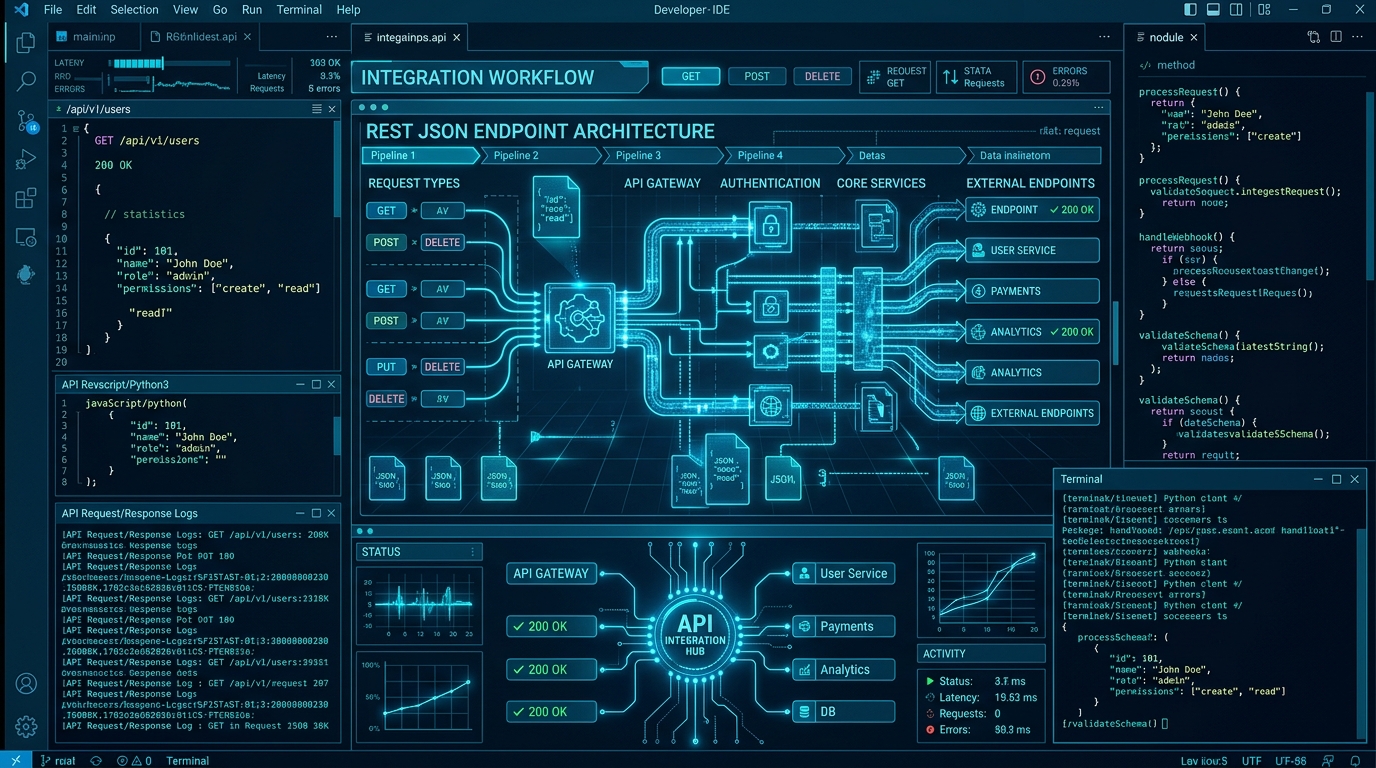
- Use client-provided Idempotency-Keys on all POST and mutation endpoints to prevent double charges.
- Design webhooks with at-least-once delivery semantics, HMAC signatures, and exponential backoff retries.
- Derive OpenAPI 3.1 specifications directly from code models to ensure docs never become stale.
- Enforce granular OAuth 2.0 scopes (e.g. `workspaces:read`, `ledgers:write`) for API integrations.
Domain Event -> Kafka / Redis Stream -> Worker Queue -> HMAC Signer -> HTTP POST to Client Webhook [Retries: 1s, 5s, 30s, 5m, 1h -> Dead Letter Queue on Failure]1. Idempotency and Webhook Delivery Guarantees
In distributed network environments, network connections fail unpredictably. If a client attempts to submit an invoice or student fee payment and the HTTP connection times out, the client cannot know whether the server executed the transaction or dropped it.
Enterprise APIs solve this challenge through client-supplied `Idempotency-Key` headers. When a mutation request arrives with an idempotency key, the API gateway caches the request state in Redis. If the client retries the exact same request due to a network glitch, the server immediately returns the cached response without re-executing the payment logic, preventing catastrophic double billing.
2. Token Bucket Rate Limiting per Tenant Tier
A well-architected API treats fair-resource allocation as a first-class citizen. Implementing the token-bucket algorithm ensures that sudden traffic spikes from one enterprise tenant do not starve shared microservices or backend databases.
API responses should always communicate rate-limiting telemetry transparently using standard headers: `X-RateLimit-Limit`, `X-RateLimit-Remaining`, and `X-RateLimit-Reset`. When limits are exceeded, descriptive JSON error payloads instruct client SDKs on the exact millisecond delay required before retrying.
3. OpenAPI Spec Generation & SDK Tooling
Documentation that is manually written in external wikis is doomed to become obsolete within months of feature development. Modern engineering teams enforce 'Code as Source of Truth' by automatically deriving OpenAPI 3.1 specifications directly from TypeScript interfaces or Go structs during build cycles.
This single OpenAPI definition powers interactive Swagger/Redoc documentation, automated SDK client generation in Python, Node.js, and Java, and end-to-end integration test suites across CI/CD environments.
4. Webhook Security and Resiliency Runbooks
Outbound webhooks notify third-party systems of real-time events like student admissions or invoice settlements. To prevent spoofing, every webhook payload must include an `X-Signature-SHA256` header calculated from the raw payload body and a tenant-shared secret key.
Failed webhook deliveries should be retried automatically using exponential backoff with jitter across a 24-hour window, eventually dropping unrecoverable messages into an accessible Dead Letter Queue (DLQ) where administrators can inspect and re-trigger events manually.