Deploying Autonomous Agentic AI in Enterprise Workflows
How multi-agent LLM systems collaborate with deterministic APIs, human approval loops, and state machines to automate complex back-office operations.
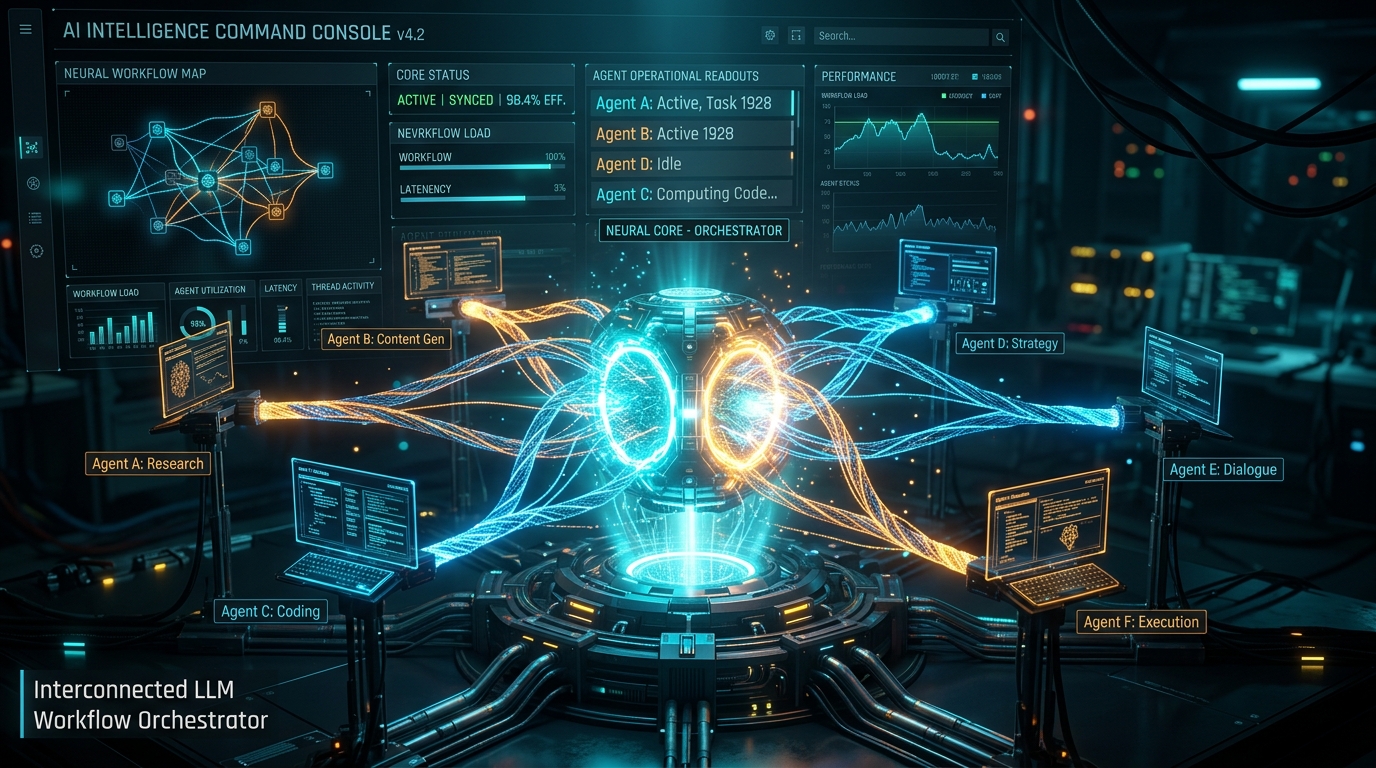
- Move beyond single prompt-response chatbots to stateful multi-agent directed graphs (DAGs).
- Equip LLM agents with strongly typed tool definitions and strict JSON schema validation.
- Implement multi-agent verification loops where a Critic or Auditor agent checks output before action execution.
- Monitor token consumption, hallucination frequencies, and latency telemetry continuously.
Task Input -> Router Agent -> [Specialist Agent A (Research) <-> Specialist Agent B (Drafting)] -> Critic Agent (Validation) -> Human Approval Gate -> API Execution Tool1. Beyond Simple Chatbots: Stateful Agent Graphs
The first generation of enterprise AI focused on simple single-turn chatbots and document search. While helpful for basic questions, these conversational models crumble when tasked with multi-step operational execution like vendor contract onboarding, procurement approvals, or clinical record synthesis.
Agentic AI represents a fundamental paradigm shift. Instead of a single LLM attempting to solve everything in one prompt, an agentic system decomposes complex business workflows into stateful directed acyclic graphs (DAGs). Individual specialized agents—such as a Data Ingestion Agent, a Policy Compliance Agent, and an ERP Integration Agent—collaborate sequentially and in parallel, passing structured context between execution checkpoints.
2. Grounded Tool Execution with Strict Schemas
An autonomous agent is only as powerful as the tools it can safely invoke. Giving an LLM open-ended code execution privileges is a severe cybersecurity hazard for enterprise platforms.
In the DEZORYN architecture, AI agents interact with production systems of record solely through strongly typed, schema-validated JSON function calls. Using validation libraries like Zod or Pydantic, the agent's intent is parsed and verified against strict business logic before any SQL mutation or financial disbursement API is triggered, guaranteeing zero unintended side effects.
3. Multi-Agent Verification and Guardrail Auditing
Hallucinations cannot be tolerated in regulated industries like healthcare, education, or finance. To achieve enterprise reliability, agent architectures employ adversarial validation pairs: every draft generated by a worker agent must be reviewed by a separate Critic Agent configured with stringent regulatory guidelines.
If the Critic Agent detects an unverified claim, a hallucinated calculation, or a missing data citation, the draft is rejected and routed back to the worker agent with corrective instructions. Only after passing multi-turn verification is the task surfaced for final human sign-off.
4. Telemetry, Cost Guardrails, and Evaluation Benchmarks
Operating autonomous agent networks at scale requires granular observability. Engineering teams must monitor token consumption, per-task inference costs, and model latency percentiles in real time.
Continuous regression testing against golden benchmark datasets ensures that updates to underlying foundation models do not degrade the accuracy or compliance posture of your automated business operations.